Chaska man collects ‘tokens of a memory.’
In the space of an hour, Rob Feeney can barely get through the CliffsNotes version of his life as a movie/television prop collector, reseller and supplier to production companies. There’re too many storied details. Too many “you can’t script this” twists in the plots. And, honestly, not enough space to write about it all with descriptions and details he deserves.
There was the time Feeney found himself in Somewhereville, Kentucky, staring at a barn full of entertainment memorabilia, one of which was the original Metro-Goldwyn-Mayer (MGM) sign, which had been stolen and missing from the Culver City, CA., east main parking lot for the better part of 40 years. “Anybody who was anybody—an actor in the movie, a janitor, whoever—went underneath this sign between 1929 and 1986,” Feeney says. There it was. “I just couldn’t believe it,” he says.
The man wanted Feeney to sell it for him, and so began Feeney’s first experience reselling with entertainment memorabilia folk. Feeney put it up on eBay, and 24 hours and 4,000 views later, he was deeply woven into comment threads, the authors of which met newcomer Feeney with some skepticism.
Other experiences rush out of Feeney with equal parts enthusiasm and urgency to get to the next story. “There’s a guy … [when he] first moved to L.A. back in 1990, he didn’t have a lot of money, and he needed a bed for his place. He ended up buying the bed that was used in that movie with Sharon Stone [the opening scene of Basic Instinct (1992)]. There’s another guy that I know that bought a bed from another Judy Garland film, and he sleeps in it.”
“There’s one guy that I know who collects all the classic outfits from the from the 1950s and ‘60s sci-fi movies,” Feeney says. “He’s got most of the Star Trek outfits. He’s just got everything you could imagine.”
Then there’s another guy … and another …
“Some collectors just store this stuff, and pull it out when they just want to look at it, wear it or display it,” Feeney says. While others just want bragging rights or are in business buying/selling. “You’ve got some collectors, who have all the money in the world, and they just want to connect to their past or their childhood,” he says.
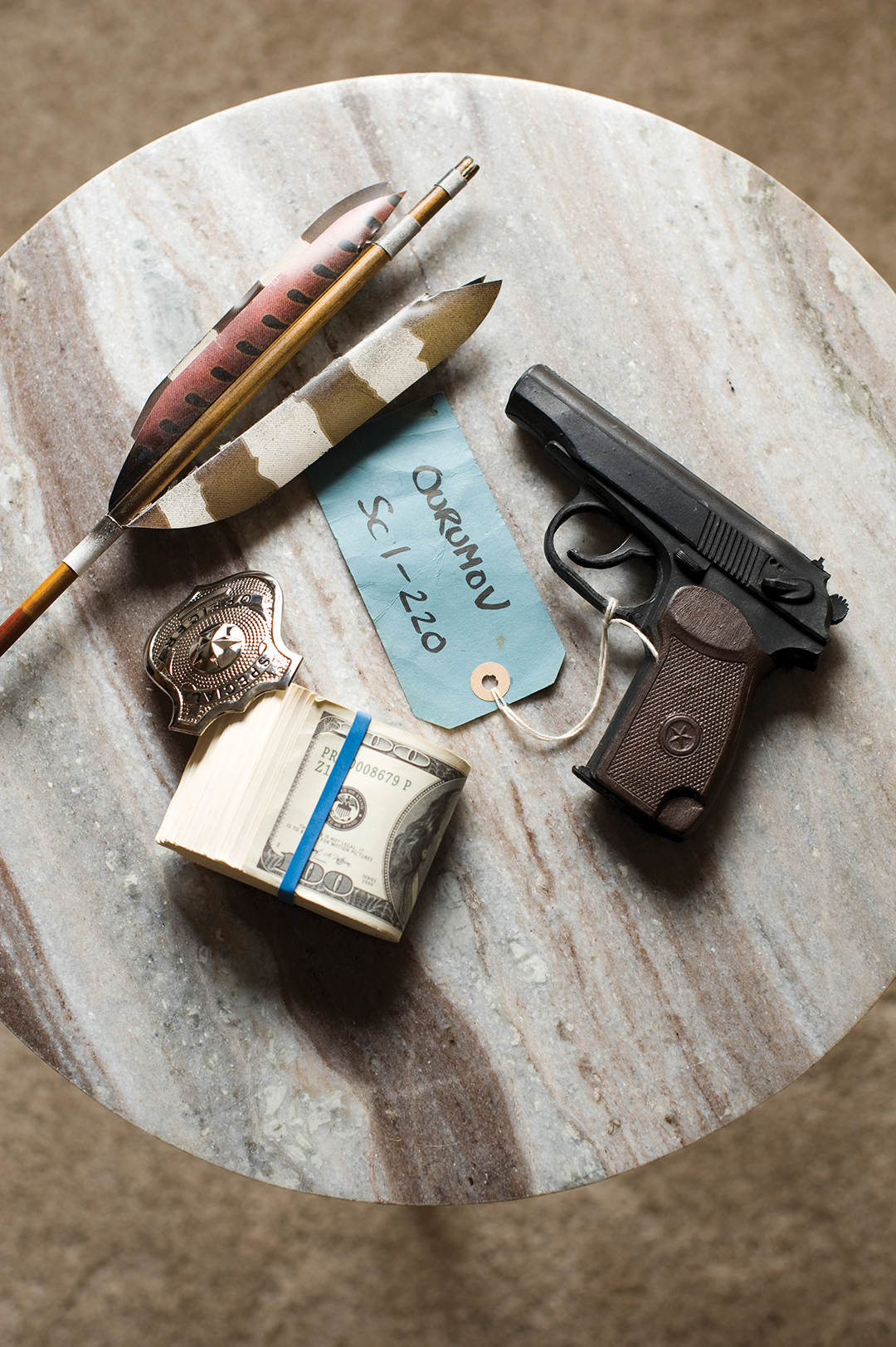
Feeney keeps his collection safely locked up in an undisclosed location, but when he met with Southwest Metro Magazine, a handful of movie props were on display in his Chaska home, including a wad of fake cash, used in Eddie Murphy’s 48 Hrs. (1982) from a Los Angeles prop company that also makes cartridges for fake cigarettes and an arrow from The Last of the Mohicans (1992).
But what got this cinephilia’s cinematic blood pumping was a tunic, worn by Errol Flynn in The Charge of the Light Brigade (1936). Flynn wore three tunics in the film, and Feeney says the one in his possession was used in opening scene, when Major Geoffrey Vickers (Flynn) rides up on his horse. (Western Costume’s name is stamped in the inside of the tunic, and it has the telltale 10 buttons, rather than eight or 12 sewn on Flynn’s other tunics.)
Feeney’s collection began about 10 years ago when he purchased the prop gun used by the villain in GoldenEye (1995) from a prop house in the United Kingdom. “I bought it, and I just got hooked,” he says. “This is my favorite piece … I paid $1,400 for it in 2008. It’s probably worth double, maybe even triple.”
“I’ve always been a movie buff,” Feeney says. “I’m a huge James Bond fan.” Owning pieces of entertainment history is gratifying for Feeney. “Having something tangible or real from something that’s make believe is, to me, it’s kind of like having a photo album. It’s a token of a memory,” he says. “There’s nothing more thrilling than actually watching the scene, and you know that pieces in your house.”
“That James Bond gun is so significant to me,” Feeney says. “My very first memory as a kid was being in the movie theater with my parents and family and seeing Live and Let Die in 1973 … It’s really nostalgic for me. Every time a James Bond movie came out, my dad was really into it, too. That was our thing.”
Feeney doesn’t just collect (he has about 15 key items); he sells items from his and others’ collections, including the tunic worn by Claude Rains (Prince John) in The Adventures of Robin Hood (1938). “I sold it for a lot of money,” he says. “… I just sold the dagger that was used [in a scene between Leonardo DiCaprio and Cameron Diaz] in Gangs of New York (2002). I sold it to some collector in Australia. [He] offered me so much money, I just couldn’t turn it down. That was from my personal collection.”
On behalf of its owner Jon Miner, founder of the Judy Garland Museum, Feeney is trying to sell the Horse of a Different Color Carriage from The Wizard of Oz (1939). “We’re selling that right now for $10 million,” he says. “It might be worth that much for the right people, but, again, it’s been really hard to sell.” That’s hard to believe, given the film’s cultural and entertainment significance. Interestingly, the carriage is said to be one of three owned by President Abraham Lincoln during the Civil War, notes Feeney. And…it was in nearly 200 other films, including John Wayne’s final movie, The Shootist (1976).
Having money in the bank to purchase such items isn’t the only qualifier to purchase these iconic items, Feeney says. He’s careful to vet purchasers, in hopes that they’ll respect the cultural and historical significances of the items. “It’s really a Wild West industry, and you would not believe the caliber of human beings that own some of these pieces,” he says. “You just wouldn’t believe it. Some of these people have no business owning some of this stuff.”

While it’s hard to narrow down the list to just a few, Feeney says many collectors search for items related to Judy Garland, Marilyn Monroe and James Dean. “[An item’s] value is broken down by the actor. That’s just a small part of it,” he says. “It’s also the scene in the film and how classic [the film is]. The ruby slippers are considered to be the Holy Grail of collecting. You got Judy Garland. You got The Wizard of Oz —the first movie that went from black and white to color; it’s the most watched film of all time.”
Collectors also seek items associated with super hero movies, Gladiator (2000), Jurassic Park (1993) and Harry Potter films, for example. “It doesn’t need to be an old movie for it to be valuable,” Feeney says. “It’s like a stock,” he adds. “Over time, usually, the stuff becomes more classic and more valuable and, obviously more rare, so it’s all those things. But the funny thing is, you never know what’s going to be valuable. Star Wars (1977) was supposed to be a flop, and so they only made, I think it was, 200 stormtrooper helmets, and they literally threw [most of] them in the trash. Twenty-five [helmets] remain. Those are worth a fortune.”
But even Feeney gets a few unpredictable inquiries. “I’ve been getting a lot of calls lately for ‘80s wardrobe pieces from [nighttime TV soap opera/drama] Dynasty for some reason,” he says. “If you can believe that.”
While he balances his full-time job with Thomson Reuters doing legal research, Feeney continues to provide props, too. “There’s very few key companies in the Midwest that supply movie and television companies with props, so that’s been a huge thing. I’m constantly getting calls for that stuff,” he says.
For his personal collection, Feeney says he would like to add James Dean’s Porsche 550 Spyder (aka Little Bastard), which he crashed in 1955 and is rumored to be hidden in a parking garage’s wall. “.., and so that’s the next thing I’m going to start looking for. I’d love to have that,” he says.
A tale of two slippers
The movie about Rob Feeney’s should be called Serendipity.
His entrée into entertainment memorabilia arrived by happenstance, as did his involvement in recovering a pair of Judy Garland’s ruby slippers from The Wizard of Oz (1939), which were stolen in 2005 from the Judy Garland Museum, Grand Rapids, MN.
“I fell into that completely by accident,” Feeney says. “I was laid off of a job [in 2013], and we were looking for home alarm systems for our house.” He decided on a system, which was being sold by a private investigation firm in Mpls.
Through the course of several conversations about the system and other matters, one of the investigators offered Feeney a job, securing clients for the small firm. Feeney declined, but, as a gesture of goodwill, he pointed them in the direction of the ruby slippers case, a crime, which could get the P.I. firm some much-needed publicity should it make inroads on the investigation.
Feeney knew Jon Miner, founder of the Judy Garland Museum, so he connected the firm with Miner, who told Feeney his timing was perfect, since the 10-year anniversary of theft was approaching.
Those investigators eventually fell away from the scene, but Feeney continued to stick with the case. To coincide with the annual Wizard of Oz Festival, hosted by the museum, and to reignite interest in the case, Feeney suggested a search of the Tioga Mine pit, where it had been rumored that the ruby slippers had been dumped after the theft.
Iron ore is the base material in the part of the state, and overt time, the pits filled with water, containing a high concentration of hydrogen, leaving the water very clear, but dangerous, nonetheless. Volunteer drivers for the Itasca County Sheriff’s Dive Team suited up for the dive.
“We connected with Twin Cities news stations,” Feeney says, but no one was calling back about covering the dive and search. Thankfully, a slow news day struck, and the dive scene ended up with about 10 media outlets in attendance. “We would have been happy with it being the top Minnesota story. That was our goal,” Feeney says. The second day, it went national.
While the slippers weren’t located in the mine pit, it did clear up that rumor from the investigation plate, and it pumped up the public’s interest in the case, which is a bit of an understatement. Six weeks after the dive, Feeney received a call from a self-proclaimed Wizard of Oz fan from Arizona. The man was willing to put up $1 million for the return of the slippers, an explanation of how the caper was executed and the identity of the thieves.
Once the offer was legitimized, it was publicly announced by Feeney and John Kelsch, executive director of the museum, in July 2015 during a press conference in Grand Rapids. Then the real fun began. “I’m in the hotel room, I kid you not, I’m watching CNN. My wife and daughter are in the next bed over. [The news crawl] comes on ‘One million dollar reward for ruby slippers.’ “I’m like, oh, my, god.” Now, the story’s gone international.
Making the mistake of including his phone number on the reward press release, Feeney was inundated with calls. “Literally, for two months—non-stop calls,” he says. He was getting tips from all over the world. One day, an older lady from Oklahoma rang up Feeney, claiming she found the ruby slippers at a garage sale. People would also claim that they stole them just to be a part of the story.
“There were a lot of people calling me with tips. Fake tips. People making fake slippers to collect a reward, good information, journalists, stalkers, crazy psychics, from all over the world. It was really scary. It was fun for like a day, and then it was it was not fun, and I’m not getting paid for this. This is all [voluntary]!”
Fast forward—a tip came to the Grand Rapids Police Department, says Sergeant Robert Stein, and the ruby slippers were recovered in 2018. “Our investigator, Brian Mattson, investigated the lead,” he says, adding that the FBI is conducting its own investigation. “We don’t want to hinder their part of the investigation because it did go beyond state lines.”
While retrieving the ruby slippers was the ultimate goal, there hasn’t been an explanation of who stole them or how in the crime unfolded—not exactly a complete Hollywood ending. Fans will just have to wait for the sequel.
“…The truth will come out, but I don’t think it’s going to happen tomorrow,” Stein says. “The FBI is doing a great job trying to get more answers, and we’re doing what we can on our end, locally.”
Once it does unfold, Stein suspects the complete story will be “stranger than fiction. It’s just a matter of time.”
Did You Know? The pair of ruby slippers owned by the Judy Garland Museum is mismatched pair with ruby slippers that are at the Smithsonian Institution in Washington, D.C.
Judy Garland Museum
2727 S. Pokegama Ave., Grand Rapids, MN; 218.327.9276